Forex scams in South Africa and how to check a licence
Forex trading is real and legal in South Africa, but the space attracts scams that imitate licensed brokers.
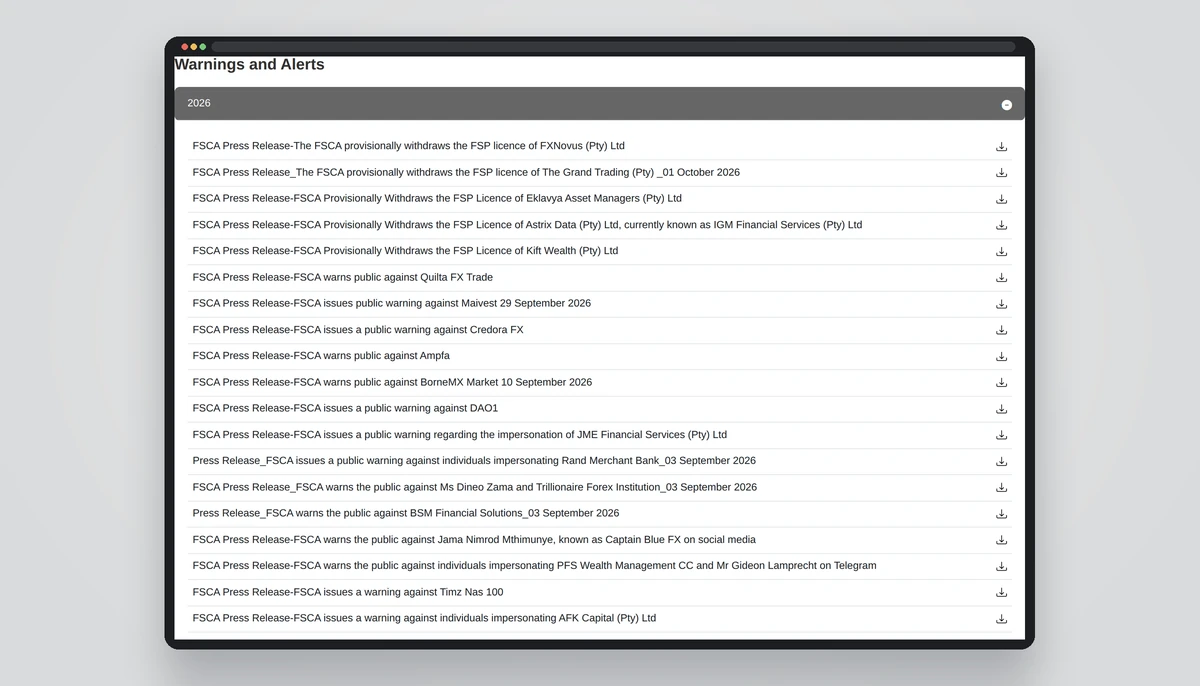
Forex trading is legal here, but that does not make every platform safe
Forex trading is a legitimate activity in South Africa, and brokers serving residents must hold the correct authorisation from the Financial Sector Conduct Authority. The problem is not the market itself. It is the number of unlicensed operators, cloned websites and app-based schemes that borrow the language of real trading while never registering with the regulator.
A broker offering leveraged foreign exchange to South African residents needs an FSCA ODP licence. That single requirement separates a firm you can complain about through official channels from one that can disappear with your deposit. Before you fund anything, confirm the licence rather than trusting a logo, a review or a social media profile.
| Platform | What it is | Who makes it |
|---|---|---|
| MetaTrader 4 | The older standard; expert advisors and a large script ecosystem | MetaQuotes |
| MetaTrader 5 | The newer build; more order types and timeframes | MetaQuotes |
| cTrader | Depth of market and a different order model | Spotware |
| The broker's own app | Usually simpler, and tied to that one firm | The broker |
A platform is software, not a safeguard: the same terminal is offered by licensed and unlicensed firms alike. App stores list software. Registers list permissions - and that is the one that matters.
The scam patterns that show up most often in South Africa
The most common pattern is the clone: a site copies a licensed firm's name, branding and sometimes its registration details, then directs deposits to a different bank account. The tell is usually the payment instruction. Money should go to an account in the licensed entity's name, not to a person or an unrelated company.
A second pattern is the app that looks like a trading platform but behaves like a pyramid. Early withdrawals are paid from new deposits, and the "profits" shown on screen are numbers, not cash. Questions about the licence are answered with screenshots instead of a verifiable FSP number.
A third pattern targets recovery. After a loss, someone contacts you promising to retrieve the funds for an upfront fee. No legitimate regulator or bank works this way. Report the original matter to the FSCA and your bank instead of paying a second time.
| What you see | What to check |
|---|---|
| A fixed monthly return, promised in advance | Ask which licence permits it, then look the firm up on the FSCA list of authorised financial services providers. |
| A deposit asked for in gift cards or vouchers | Check the broker's own funding page: firms list bank, card and wallet rails, not vouchers. |
| Someone offering to trade the account for you | Managing money for a client is a separate permission. The register says whether a firm holds it. |
| A withdrawal released only after a new payment | Read the withdrawal terms you agreed to. Fees devised at the moment of payout are not among them. |
None of this is a judgement about any firm. Each line is a check you can run yourself, starting at fsca.co.za.
How to check an FSCA licence in a few minutes
Go to fsca.co.za and open the FSCA list of authorised financial services providers. Search the firm's name, then match the FSP number it quotes against the register entry. The name, number and authorised services should line up exactly.
Check the entity, not the app. A trading app may be a product name with no licence of its own, so ask which legal entity holds the FSCA authorisation and whether that entity is the one receiving your money. If the answer is vague, treat it as a refusal.
Confirm the payment details separately. In South Africa, funding usually moves by EFT or instant EFT, and services such as Ozow and Capitec Pay are common, along with card and bank transfer. Whatever the rail, the beneficiary name should match the licensed entity. If it does not, stop.
What the FSCA register is
- Regulator
- Financial Sector Conduct Authority (FSCA)
- Register
- FSCA list of authorised financial services providers
- Published at
- fsca.co.za
- Covers retail forex
- Yes — the register has a category for it
- Last read by us
- 2026-09-29
- Entries transcribed here
- 30
A register says whether a firm holds a licence on the day you look, and nothing about how it treats clients. Search by the registered company in the footer rather than the name on the homepage.
Risk management is your own job, not the platform's promise
Leverage magnifies losses as readily as gains, which is why risk management tools matter more than any signal group. Position sizing, a stop loss on every trade and a limit on how much of your account is exposed at once are basic controls, not advanced tactics. None of them removes the risk of losing money.
Local session hours shape when you can act on those controls. Sydney runs 23:00 to 08:00 SAST, Tokyo 02:00 to 11:00 SAST, London 10:00 to 19:00 SAST and New York 14:00 to 23:00 SAST. The London and New York overlap, 14:00 to 19:00 SAST, is when activity is typically heaviest and stops can be triggered fastest.
Keep records in rand. Your deposits, withdrawals and any gains or losses are ZAR amounts, and your bank statement is the record that matters if a dispute arises. A platform dashboard is not evidence of a licensed relationship.
| Figure | Source | Checked |
|---|---|---|
| Licensee names and status | FSCA list of authorised financial services providers — fsca.co.za | 2026-09-29 |
| Session windows | Fixed UTC windows; London and New York shift in their DST | On change |
| USD/ZAR | open.er-api.com | 2026-09-28 |
| Funding limits and fees | Set by the provider and the broker — not published here | Changes without notice |
Undated figures are opinions in disguise. What we could not trace back to a source was dropped rather than guessed at.
A licence check that stops at the company name proves very little
The FSCA list is searched by the name of the licensed financial services provider, not by the website you are looking at. A platform can trade under a brand that appears nowhere on the register while a licensed entity sits somewhere behind it. Copy the legal name from the site's terms page, not the logo.
Then compare what the licence actually permits. A provider may be authorised for one category of financial service and not for the activity being sold to you. The register entry describes the scope, and that scope is the part most people skip.
If the brand name and the licensed name do not match, ask the platform to explain the relationship in writing before any money moves. A vague answer is itself the finding. Send the question to the compliance contact, not to a chat agent.
The paperwork, and what each piece proves
- Green barcoded ID book or smart ID card, or passport
- Who you are
- Selfie with the ID document
- That the document is in your hands
Brokers usually also ask for proof of address - municipal bill or bank statement; requirements differ per firm. The firm's own sign-up page is the list that counts.
A screenshot of a certificate is not a licence check
Scam pages often display a certificate image, a registration number in the footer, or a badge that looks official. None of these are verification. The only check that counts is finding the entity yourself on the FSCA list at fsca.co.za, starting from the regulator's site rather than from a link the platform supplied.
Links in an email or on a broker page can point to a lookalike domain. Type the regulator's address manually or use a saved bookmark. If the platform's own page links to its proof of regulation, treat that link as marketing material.
The same applies to PDFs and screenshots sent by a recruiter or an account manager. Documents can be edited. The live register entry is the thing that changes when a licence lapses, and it is the thing worth reading.
| Figure | Value | Source |
|---|---|---|
| Indicative USD/ZAR | 16.32 | open.er-api.com, pulled 2026-09-28 |
| How often it moves | Every trading day | — |
| The rate your account uses | Your broker's own conversion | The broker's rate card |
| Symbol on this site | R | — |
An indicative rate is for sizing a position in your head, not for settling one. That spread between the market rate and the broker's own is a cost worth counting.
Deposits by EFT leave you with a weaker recovery position than card payments
Most South African traders fund accounts by EFT, instant EFT, Ozow, Capitec Pay or a plain bank transfer. These rails push money out of your account and into someone else's. Once the transfer settles, the bank is generally not in a position to reverse it on your instruction.
Card payments sit differently, because a card scheme dispute process exists and can be triggered within defined windows. That difference matters when a platform stops responding. It does not make card funding safe, and it does not guarantee a refund, but it preserves an option that EFT removes.
If you choose EFT, keep the proof of payment, the beneficiary account details and the reference you used. Those records are what a bank or the authorities will ask for. Reconstructing them months later from an app is harder than saving them at the time.
| Rail | What it is | Who sets the limit and the fee |
|---|---|---|
| EFT / instant EFT | Bank transfer | Your bank and the broker |
| Ozow | Payment service | The provider and the broker |
| Capitec Pay | Payment service | The provider and the broker |
| Card | Card payment | Your card issuer and the broker |
| Bank transfer | Bank transfer | Your bank and the broker |
Limits and fees are set by the provider and the broker and change without notice, so they are not printed here. Verify it twice, once in the app and once on the funding page, and never withdraw to an account that did not fund you.
Pressure to deposit quickly is a control tactic, not a service
Common local patterns include a friendly account manager, a WhatsApp or Telegram group with posted wins, and a limited-time bonus for funding today. The urgency is the mechanism. It is designed to move you past the licence check and past the decision to start small.
A genuine provider does not need you to fund before you have read the terms, confirmed the legal entity and understood how withdrawals are processed. Ask what the withdrawal process is, in writing, before depositing. Then ask how long a withdrawal has taken for other clients, and note whether the answer is specific or deflected.
The order of operations is the defence. Verify the entity, read the withdrawal terms, make a small first deposit, and test a withdrawal before committing more. Any platform that resists that sequence has told you what you need to know.
| Part of the day | Local time · SAST |
|---|---|
| Busiest window | 14:00-19:00 SAST — London and New York open together |
| Thinnest stretch | 23:00-08:00 SAST — Sydney alone, wider spreads |
| European open | 10:00-19:00 SAST |
| US open | 14:00-23:00 SAST |
| Closed | Friday New York close until the Sydney open on Monday |
Hours are shown for the clocks in force today: London is on GMT until 28 March, New York is on EDT until 1 November. South Africa does not change clocks, so each move shifts these local times by an hour and the page is rebuilt on the day it happens.
Withdrawal friction is the failure mode that appears after the deposit
Scams rarely block the first deposit. The friction arrives at withdrawal, when a new condition appears: a verification fee, a tax clearance requirement, a minimum trading volume, or an account upgrade before funds can be released. These conditions were usually buried in terms you were encouraged not to read.
No legitimate request for an upfront payment to release your own balance should be met with a payment. That request is the scam continuing, not a step towards recovery. Stop sending money and stop engaging with the account manager.
Report the matter to the FSCA and to your bank promptly, and keep every message, reference number and statement. Recovery is not guaranteed and timelines are outside your control, which is precisely why the verification step belongs before the deposit rather than after it.
Questions we are asked
The activity is real and legal, and licensed providers operate here under FSCA oversight. Scams exist alongside them, usually unlicensed clones or app schemes that never appear on the FSCA register. The distinction is the licence, not the word forex.
Find the legal entity behind the app, then search that name on the FSCA list of authorised financial services providers at fsca.co.za and match the FSP number. Check that your EFT or instant EFT payment goes to an account in that same entity's name. If either step fails, do not deposit.
Use stop losses, size positions so a single loss cannot damage the account, and cap total exposure at any one time. Trade within sessions you can monitor, such as the London and New York overlap from 14:00 to 19:00 SAST, and keep your own ZAR records. Tools reduce the size of a loss, they do not prevent one.